GERD — gastroesophageal reflux disease — is what doctors call chronic acid reflux, and in Ayurveda it’s known as Amlapitta. It happens when stomach acid keeps flowing back into the esophagus, causing heartburn, regurgitation, and that burning sensation behind the chest. Millions of Indians deal with it, which is exactly why acidity and digestive-health products remain one of the steadiest categories in the Ayurvedic manufacturing business. If you’re searching for GERD medicine — whether you need it, sell it, or want to manufacture it — this guide covers all three angles, then gets into what actually matters if you’re building a brand around it.
What Is GERD Exactly?
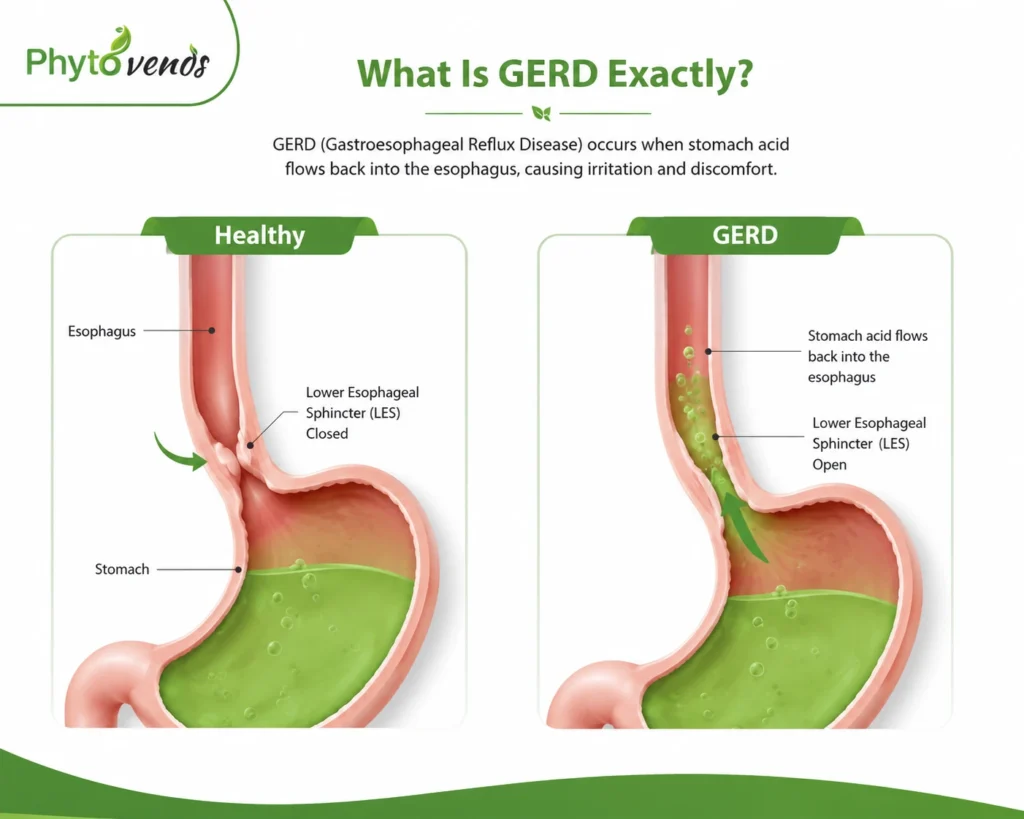
GERD is a digestive condition where the lower esophageal sphincter — the muscle that’s supposed to keep stomach acid where it belongs — doesn’t close properly. Acid escapes upward, irritates the esophagus, and produces the classic symptoms: heartburn, a sour taste, chest discomfort, and sometimes a persistent cough. Occasional acid reflux isn’t GERD. It becomes GERD when it happens more than twice a week, or when it starts damaging the esophageal lining over time.
Common triggers include spicy or fried food, eating late at night, obesity, smoking, and stress — which is also why Ayurveda has always treated it as a lifestyle-and-diet condition first, medicine second.
GERD Treatment: Home Remedies, OTC Medicine, and Prescription Options
There isn’t one single fix for GERD — treatment usually falls into three tiers, and most people move through all three depending on severity.
Home Remedies for GERD
Mild, occasional acidity often responds to simple dietary changes: smaller meals, cutting back on caffeine and fried food, not lying down right after eating, and keeping the head slightly elevated at night. Ayurveda adds a few specific tools here — cooling herbs like Amla (Indian gooseberry) and mild digestives like fennel or jeera water, which calm the “pitta” imbalance believed to drive acid reflux. These help, but they’re maintenance, not treatment for anything beyond mild symptoms.
Over-the-Counter (OTC) GERD Medicines
When home remedies stop working, most people reach for OTC antacids and heartburn medicine — the kind you can buy at any pharmacy counter without a prescription. This is also where Ayurvedic OTC options come in: classical formulations like Avipattikar Churna and mineral-based Kamadudha Ras are widely sold over the counter for moderate acidity, and they’re a major reason GERD-related product lines do well for Ayurvedic brands. They’re accessible, they don’t need a doctor’s sign-off, and repeat purchase is high — which is exactly why this segment is worth manufacturing, not just selling.
Prescription GERD Medicine
Chronic or severe GERD — where symptoms disrupt sleep or daily life, or where there’s visible esophageal damage — usually needs a doctor’s prescription. In conventional medicine, that means proton pump inhibitors or H2 blockers. In Ayurveda, the equivalent is closer to Sutshekhar Ras or other mineral-based Rasayana formulations, which are stronger and are meant to be taken under a qualified Ayurvedic practitioner’s supervision rather than self-administered. If you’re manufacturing in this category, this is the tier where formulation accuracy and quality testing matter most — it’s not a place to cut corners.
Types of GERD Medicine Formulations
GERD and acidity products aren’t sold in just one format, and the format matters as much as the formula when you’re building a product line.
Tablets and capsules are the most common — easy to dose, easy to transport, and what most pharmacy buyers expect on the shelf. Syrups and liquids work faster for acute heartburn and are popular for products aimed at quick relief or for patients who find tablets harder to take. There’s also a smaller but steady demand for GERD-related cough formulations — reflux-induced cough is common enough that a dedicated syrup for it fills a real gap most general acidity ranges miss.
A manufacturer that can produce across all three formats — tablet, syrup, and classical churna/ras forms — gives a PCD partner more flexibility to build a complete digestive-care range under one brand, instead of sourcing formats from different vendors. Our guide on tablet manufacturing standards goes deeper into what separates a reliable tablet manufacturer from one cutting corners, if that’s the format you’re starting with.
Why Ayurveda for GERD? The Case for a Natural Drug of Choice
Conventional GERD medicine works by suppressing acid production. Ayurveda takes a different route: it treats acidity as a pitta imbalance and works on digestion, gut lining repair, and overall balance rather than just blocking acid. That’s the real differentiator, and it’s worth explaining plainly, not just claiming.
Classical Ayurvedic formulations used for Amlapitta include Amla for its cooling, acid-neutralizing effect; Licorice (Mulethi) to soothe an irritated stomach lining and calm reflux-related throat irritation; Shatavari for gut-lining repair in cases where dryness worsens acidity; Triphala for bowel regularity, which indirectly reduces pressure on the digestive tract; and Guduchi for its anti-inflammatory support. For moderate, recurring GERD, Avipattikar Churna and Triphala are the typical go-to combination. For chronic or severe cases, Kamadudha Ras and Sutshekhar Ras are the classical drugs of choice — but these are mineral-based (bhasma) formulations and genuinely need to be manufactured under strict quality control and taken under supervision, not sold loosely as a general wellness product.
This is also where a lot of smaller Ayurvedic brands fall short — anyone can print “Ayurvedic” on a label, but formulating mineral-based Rasayana products correctly, with consistent potency and no contamination, is a manufacturing discipline, not a marketing claim.
PhytoVends — Ayurvedic GERD Medicine Manufacturer in India
PhytoVends manufactures Ayurvedic and herbal digestive-care products from our facility in Zirakpur, Punjab, under WHO-GMP and ISO 9001:2015 certification, with AYUSH-compliant processes across the board. For a category like GERD and acidity — where formulation accuracy genuinely affects whether a product works — that certification isn’t paperwork, it’s the difference between a batch that performs consistently and one that doesn’t.
Our product range covers the formats GERD and acidity brands actually need: tablets and capsules, syrups, and classical churna/ras preparations, along with the broader digestive-health category — so a partner isn’t stuck sourcing one product from us and three others elsewhere. Every batch goes through documented quality checks before it ships, and we handle both the formulation and the packaging side, so what reaches the shelf matches what was tested.
Start Your Own GERD Medicine Brand in India
If you’re a healthcare professional, distributor, or entrepreneur looking to enter the acidity and digestive-care segment, there are two practical routes in.
Third-party manufacturing means we produce the GERD/acidity products under your brand name — you bring the brand, we bring the formulation, facility, and compliance. You skip the capital cost of setting up your own manufacturing unit entirely.
Ayurvedic PCD franchise works differently: you get monopoly distribution rights for our existing GERD and digestive-care range in your chosen territory, and you focus purely on sales and distribution rather than production.
Investment for third-party manufacturing or a PCD franchise with PhytoVends typically starts around ₹25,000–₹50,000, scaling up depending on the product range and order volume — a fairly low bar to enter a category with consistent, repeat-purchase demand. If you’re weighing manufacturers before committing, our breakdown of the best Ayurvedic medicine manufacturers in India covers what to check beyond just price.
FAQs
What is the best Ayurvedic medicine for GERD?
Depends how bad it is. Mild, occasional acidity responds well to Amla, Licorice, and Guduchi. Once it’s recurring — a few times a week, bloating included — Avipattikar Churna paired with Triphala is the usual go-to. For chronic or severe GERD, practitioners lean on Kamadudha Ras or Sutshekhar Ras. Both are mineral-based, so don’t self-prescribe those two — get an Ayurvedic doctor’s input first.
Can you buy Ayurvedic GERD medicine without a prescription?
For the most part, yes. Avipattikar Churna and Kamadudha Ras sit on pharmacy shelves as OTC products. Sutshekhar Ras is technically available OTC too, but given it’s a heavier mineral formulation, it’s worth using under a practitioner’s guidance rather than picking it up on your own.
What’s the investment to start a GERD or acidity product brand?
₹25,000–₹50,000 gets you started through third-party manufacturing or a PCD franchise. Building your own manufacturing unit from scratch costs a lot more — most people don’t go that route until they’ve already proven the brand works.
Which certifications actually matter when picking a manufacturer?
Three: WHO-GMP, an AYUSH manufacturing license, and ISO 9001:2015. Anyone can claim “quality” on a website — these three are the ones that actually get audited, so ask to see the certificates, not just the logos.
Can I sell GERD medicine under my own brand without owning a factory?
Yes — that’s the entire point of third-party manufacturing. PhytoVends formulates, tests, and packs the product; it ships out with your label on it. No factory, no machinery, no in-house pharmacist required.