
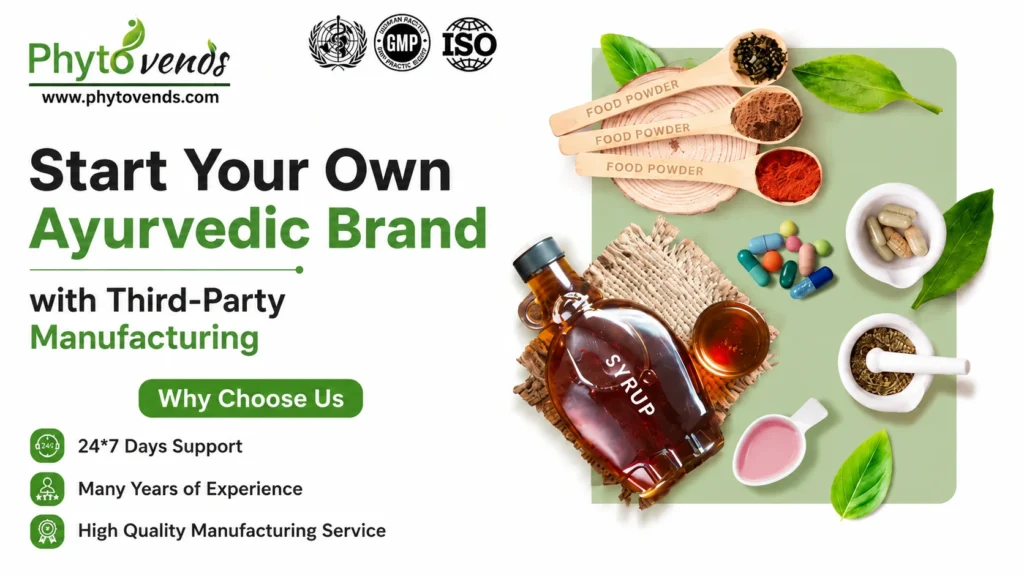
Creating a wellness brand from scratch can feel overwhelming. Establishing a factory, purchasing heavy machinery, and recruiting expert chemists require huge capital and technical knowledge.
Fortunately, you don’t have to build a factory to bring out high-quality herbal products. Partnering with an Ayurvedic third-party manufacturing company lets you build your herbal business quickly, safely and affordably — without owning the plant, machinery, or in-house chemist team yourself.
What Is Ayurvedic Third-Party Manufacturing?
Ayurvedic third-party manufacturing is a business model where you outsource production of Ayurvedic products or Ayurvedic medicine to a licensed, WHO-GMP certified Ayurvedic third-party manufacturer, who makes the products under your own brand name and specifications. You don’t need a factory, machinery, or in-house chemists — you handle branding and sales while the manufacturer handles production. This is the same model whether you’re evaluating one Ayurvedic third-party manufacturing company or shortlisting several ayurvedic third-party manufacturers in India before choosing one.
Third-Party Manufacturing vs. PCD Franchise — What’s the Difference?
Third-party manufacturing and PCD franchise both let you sell Ayurvedic products without owning a factory, but they differ in ownership. In third-party manufacturing, you own the brand name, formula, and packaging, and can sell anywhere in India or internationally. In a PCD franchise, you sell an existing company’s products under their brand name, with exclusive distribution rights limited to your assigned territory.
| Comparison Factor | Third-Party Manufacturing | PCD Franchise |
| Brand Ownership | Own your brand, packaging, and product identity. | Market products under the parent company’s brand. |
| Product Formulation | Can be customized to your requirements. | Pre-approved formulations with no customization. |
| Market Rights | Freedom to sell across India or export globally. | Limited to the allotted monopoly or distribution territory. |
| Initial Investment | Higher investment for branding, packaging, and MOQ. | Lower investment using the company’s existing brand. |
| Ideal For | Businesses planning to build a long-term pharmaceutical brand. | Entrepreneurs looking for a quick and low-risk market entry. |
If your goal is to build something that’s genuinely yours — brand, formula, and future resale value — third-party manufacturing is the stronger path. If you want to start selling faster with less upfront branding work, PCD franchise is the quicker route in.
Why Brands Choose Contract Manufacturing Over Setting Up Their Own Unit
Establishing a manufacturing plant requires huge infrastructure investment, environmental clearances, land acquisition and maintenance. Third-party manufacturing of Ayurvedic products removes these high entry barriers.
You can outsource production to startups and established companies offering an Ayurvedic third-party manufacturing service.
It lets you focus all your energy on branding, sales and customer service, while manufacturing is fully outsourced to industry specialists.
What Products Can You Manufacture Through Ayurvedic Third-Party Manufacturing?
Ayurvedic third-party manufacturers in India typically produce across all major dosage forms, so your product choice isn’t limited to one category. Common lines include capsules and tablets, herbal syrups and ras preparations, hair and body oils, shampoos and hand washes, face and body lotions, gels, mouthwashes and pastes, oral drops, energy drinks and glucose formulations, and classical Ayurvedic drugs. Some manufacturers also offer combo packs that bundle two or more product types under one brand launch.
Not every manufacturer supports every category — a facility set up for liquid syrups may not run tablet-compression lines, for example. Confirm which categories a manufacturer’s WHO-GMP license actually covers before you commit to a product line.
Ayurvedic Third-Party Manufacturing Market in India — Why the Timing Works
India’s Ayurvedic products market was valued at ₹1,017.51 billion in 2025 and is projected to grow at a CAGR of 15.52% through 2034 (Source: IMARC Group, 2026 market report). That growth curve is exactly why third-party manufacturing has become the default way to enter the category — demand is expanding faster than any single new brand can build its own WHO-GMP facility from scratch. Partnering with an established Ayurvedic third-party manufacturer lets you launch and start capturing market share in weeks instead of the 12–18 months (and several crores) a self-owned unit typically takes to get licensed and operational.
How to Start Your Own Ayurvedic Brand (Step-by-Step Process)
Here is a step-by-step procedure to launch your Ayurvedic brand with third-party manufacturing:
- Decide what you are going to sell. Herbal syrup, Hair oil, capsules or immunity boosters?
- Choose a brand name and logo
- Choose a manufacturer that has certificates like WHO-GMP and AYUSH.
- Sign the contract.
- Know prices, terms and timeframes
- Time to launch and promote your products when they are produced and shipped.
How Much Investment Is Needed to Start an Ayurvedic Brand?
Most new Ayurvedic brands start with ₹1.5 lakh to ₹5 lakh in initial investment through third-party manufacturing. Capsules and tablets cost the least; syrups, oils, and premium cosmetics cost more due to bottling and raw material differences. A self-owned manufacturing unit, by comparison, can run into several crores once you factor in land, machinery, GMP compliance, and licensing.
What Factors Affect Your Total Investment?
- Product Type — Liquid syrups, tablets, capsules, ointments, and premium hair oils each have different raw material and processing costs.
- Batch Quantity — Higher order volumes bring down your cost per unit.
- Packaging Materials — Custom glass bottles, premium outer cartons, and specialised pumps cost more than standard plastic packaging.
- Standard vs. Custom Formulations — Pre-approved standard formulations cost less than custom R&D formulas.
What Is the Minimum Order Quantity (MOQ) for Ayurvedic Contract Manufacturing?
MOQ typically ranges from 500–1,000 bottles for liquid syrups to 10,000–30,000 units per batch for tablets and capsules, depending on the manufacturer.
Licenses & Certifications You Should Check Before Partnering
Before signing with any Ayurvedic manufacturer, verify their certifications and the documents they’ll require from you — this is the most common source of compliance delays later.
Certifications the Manufacturer Should Hold
A manufacturer should hold WHO-GMP, ISO, and AYUSH certification. WHO-GMP and ISO confirm the facility meets international manufacturing and quality standards. AYUSH certification is Ayurveda-specific and governs traditional medicine formulations in India.
- WHO-GMP — international good manufacturing practice standard
- ISO — quality management certification
- AYUSH — required for Ayurvedic/traditional medicine compliance in India
PhytoVends holds WHO-GMP and ISO certification and provides AYUSH documentation support for private label brands.
Documents You Need to Submit to the Manufacturer
You’ll typically need four documents: GST registration, company PAN card, business registration proof, and trademark registration or application for your brand name.
- GST registration certificate
- Company PAN card
- Business registration proof — proprietorship, partnership, or incorporation documents
- Trademark registration — or a declaration of ownership if not yet registered
Exact requirements vary by manufacturer, so confirm with your partner before signing.
How to Compare Ayurvedic Third-Party Manufacturers in India
With dozens of Ayurvedic third-party manufacturing companies advertising online, the practical way to shortlist is to check the same four things for each one:
Certification numbers, not badges.
Ask for the actual WHO-GMP, ISO, and AYUSH license or registration numbers and verify them independently — a badge image on a website proves nothing on its own.
MOQ against your launch budget.
A manufacturer’s minimum order quantity should match what you can realistically sell in your first cycle, not force you into overstock.
A sample batch before full production.
Reputable manufacturers will run a small sample or pilot batch so you can test quality before committing to your full MOQ.
Written turnaround commitments.
First-order timelines and repeat-order timelines should be confirmed in writing, not verbally, since delays here are the most common source of launch friction.
A manufacturer that’s transparent on all four is generally reliable. One that pushes you toward a larger MOQ than you asked for, or won’t share certification numbers directly, is a warning sign worth taking seriously.
Private Labelling vs. Contract Manufacturing — Which One Do You Need?
Private label Ayurvedic products manufacturing means you pick from a manufacturer’s ready formulations and put your brand name on them. It’s fast and low-cost.
Contract manufacturing for Ayurvedic products goes further. The manufacturer creates a formulation to your exact specifications: proprietary herb blend, unique dosage form or custom fragrance. It takes more time and a higher MOQ, but the product line is genuinely your own.
Speed matters most? Go private label. Want something different? Choose contract manufacturing.
Or you can read this complete guide on Ayurvedic Contract Manufacturing vs Third-Party Manufacturing to understand more clearly.
Why Choose PhytoVends for Your Ayurvedic Third-Party Manufacturing
PhytoVends is a WHO-GMP and ISO certified Ayurvedic third-party manufacturing company based in Zirakpur, Punjab, handling third-party manufacturing of Ayurvedic products and Ayurvedic medicine for brands across India and international markets.
- We source high-grade raw materials from verified suppliers, with batch-level traceability.
- Our in-house team includes Ayurvedic Vaidyas, formulation researchers, and quality technologists who review every formula before production begins.
- We handle the full cycle — formulation, WHO-GMP compliant production, packaging, and AYUSH documentation support — under one roof.
- Every batch is tested and documented under our GMP-certified quality process, so you can verify compliance instead of taking our word for it.
FAQs
1. How quickly is a third-party Ayurvedic batch manufactured?
First order usually takes 30-45 days as it needs label design approvals, packaging procurement and batch production. Repeat orders usually go through the process faster and can be completed in about 15-25 days.
2. Can I send my own formulation to the manufacturer?
Yes. Most contract manufacturers accept custom formulas and test them for safety, stability, and regulatory compliance before production begins.
3. Do I need my own manufacturing license for third-party manufacturing?
No. Since production happens at the manufacturer’s licensed facility, you only need standard commercial registrations — GST number, trademark, and marketing license.
4. What is the shelf life of Ayurvedic products manufactured by a third party?
The Ayurvedic liquid preparations, tablets and topical formulations generally have a shelf life of 24 to 36 months under the recommended storage conditions.
5. How do I choose a reliable Ayurvedic third-party manufacturing company in India?
Check three things before signing: certifications (WHO-GMP, ISO, AYUSH), MOQ that matches your launch budget, and turnaround time on your first batch. Ask for certification numbers directly rather than trusting website badges, request a sample batch before committing to full production, and confirm in writing what documents they’ll need from you (GST, PAN, business registration, trademark). A manufacturer that’s transparent about all four is usually reliable — one that pressures you into a larger MOQ than you asked for is a warning sign.
6. Is Ayurvedic medicine third-party manufacturing different from third-party manufacturing for cosmetics or wellness products?
Yes. Ayurvedic medicine third-party manufacturing — classical and proprietary formulations — requires AYUSH licensing and drug-specific regulatory review. Third-party manufacturing for Ayurvedic cosmetics, oils, and general wellness products typically only needs FSSAI or cosmetic manufacturing licensing. The production process (WHO-GMP facility, batch testing, packaging) is similar for both, but confirm which license category your specific product falls under before signing with a manufacturer.
7. What products can Ayurvedic third-party manufacturers in India produce?
Most manufacturers cover capsules, tablets, syrups, oils, shampoos, hand washes, lotions, gels, drops, energy drinks, and classical Ayurvedic formulations. Not every facility runs every category, so confirm which product types are covered under a specific manufacturer’s WHO-GMP license before finalizing.
8. Can Ayurvedic third-party manufacturing be used to export products outside India?
Yes — WHO-GMP certification is internationally recognized, which is why most brands exporting Ayurvedic products manufacture through a WHO-GMP certified third-party facility. That said, the destination country will usually have its own import and labeling regulations on top of Indian certifications, so confirm those requirements separately before shipping.
Ready to Launch Your Ayurvedic Brand?
One of the smartest, most cost-effective ways to enter the booming wellness industry is to start your own Ayurvedic brand via third-party manufacturing. It frees you from the financial burden of managing facilities. This helps you focus entirely on marketing and engaging customers.
When you partner with a WHO-GMP, ISO and AYUSH-documented manufacturer, you know that every product carrying your brand name is verifiably compliant — not just described as such. Take the first step today, define your product vision and bring your Ayurvedic brand to life!