To make the problems a bit easier there are manufacturing companies who are willing to help you in every aspect. Phytovends is one of these companies. Hence they are introducing a new range of innovative herbs which form a part of ayurvedic medicines to the various areas in India encountering varying demands. Now you have the opportunity to reach out to the best shilajit manufacturer for the most exceptional help.
Phytovends is the well established Private Label shilajit manufacturer, exporters, and suppliers of Shilajit powder and extracts in the ayurvedic market in India. Actually, to supply the best quality extracts of Shilajit and maintain a very high level and purity in all over India. In India, the extracts and raw materials used in Ayurvedic shilajit manufacturing are carried out with proper care and purity.
Shilajit Benefits: Benefits of Shilajit for Male and Female
Shilajit is among the most beneficial products when it comes to Ayurvedic Treatment. It is a natural herb that can be harvested from plants and other natural herbs. In addition, this is caught between rocks in the mountains and will be there inside decades and decades of years. The deposits obtained from this herb are then blended perfectly to get a form of medicine. The effects of Shilajit are remarkable not only in the treatment of male diseases, but for a great many other illnesses, covered one by one below.
Helps in Healthy Weight Gain
Shilajit for weight gain works by improving mitochondrial energy production and helping the body absorb nutrients more efficiently, making it easier to sustain the diet and strength training that healthy weight gain actually depends on.
Improves Skin Health and Reduces Wrinkles
Among the benefits of Shilajit for skin, its antioxidants and fulvic acid fight the free-radical damage behind dullness and premature wrinkles, supporting collagen production and skin elasticity for a firmer, more even-toned appearance from the inside out.
Supports Women’s Health and Hormonal Balance
The benefits of Shilajit for women include support for hormonal balance, steady energy, and immunity through different life stages, including menstruation and menopause — though pregnant or breastfeeding women should consult a doctor before use.
Boosts Men’s Testosterone and Vitality
The benefits of Shilajit for men center on testosterone support and physical stamina. As the Andrologia study below shows, purified Shilajit taken daily for 90 days was linked to a measurable rise in testosterone in healthy men.
Supports Heart and Cardiovascular Health
The benefits of Shilajit for heart health come from its anti-inflammatory and antioxidant compounds, which are associated with better cardiovascular function and healthier blood lipid levels when used alongside a balanced lifestyle. Anyone with an existing heart condition should check with a doctor first.
Aids Muscle Recovery for Gym and Fitness
Shilajit for gym men is popular as a natural support for muscle recovery and endurance during workouts, helping reduce workout fatigue by aiding mitochondrial function alongside proper training and nutrition.
Increases Energy and Fights Fatigue
Fatigue is one of the top reasons people try Shilajit in the first place. Its fulvic acid content supports mitochondrial function — the cell’s energy engine — for steadier energy through the day without a caffeine-style crash.
Strengthens Bones and Joints
Shilajit is traditionally used in Ayurveda to support joint comfort and bone strength through its mineral content and anti-inflammatory action, often for people managing everyday joint stiffness or supporting bone density as they age.
Boosts Immunity and Slows Visible Aging
With over 80 trace minerals and a strong antioxidant profile, Shilajit supports immune resilience and helps neutralize the free radicals behind premature aging — the core reason it’s classified as a Rasayana, or rejuvenator, in Ayurveda.
Helps in Managing Diabetes
Shilajit is traditionally used in Ayurveda to support healthy blood sugar levels through its mineral and antioxidant content, often included in Ayurvedic diabetes-support formulations — though it isn’t a replacement for prescribed treatment.
Supports Urinary Tract (UT) Health
Shilajit has long been used to support urinary tract health and help the body deal with mild UT discomfort, thanks to its natural anti-inflammatory action.
Restores and Repairs Body Tissues
Rich in fulvic acid and minerals, Shilajit supports the body’s natural tissue-repair process, from muscle recovery after exertion to general cellular restoration — a big part of its rejuvenating reputation.
Improves Intelligence and Memory
Shilajit is used as a natural nootropic to support memory, focus, and mental clarity, with antioxidant properties believed to protect brain cells from the oxidative stress linked to age-related cognitive decline.
Helps Build Muscle Strength
Beyond gym recovery, Shilajit is used more broadly to build and maintain muscle strength by supporting protein synthesis and energy metabolism — useful for athletes and older adults alike working to preserve muscle mass.
Improves Digestion
Shilajit is traditionally taken to support digestion, helping with nutrient absorption and easing common digestive sluggishness through its mineral content.
Enhances Complexion and Natural Glow
Shilajit is used specifically to even out complexion and add a natural glow, thanks to improved circulation and its detoxifying, antioxidant-rich profile.
Helps Stimulate Appetite
For people dealing with low appetite, Shilajit is traditionally used as a natural appetite stimulant, helping restore a regular eating pattern.
Fights Cold, Cough and Fever
Shilajit is traditionally used for its anti-cold, anti-cough, and anti-fever action, supporting the body’s natural immune response during seasonal illness.
Helps with Breathing Problems
Ayurvedic use of Shilajit extends to respiratory support, helping ease breathing problems as part of a broader immunity and wellness routine.
Supports Eye Health
Shilajit is used in traditional Ayurvedic eye-care formulations, drawing on its mineral content and anti-inflammatory properties for general eye wellness.
Helps Control Hiccups
A lesser-known traditional use, Shilajit is included in some Ayurvedic remedies aimed at controlling recurring hiccups, tied to its broader role in digestive and nervous-system balance.
Helps Prevent Piles
Shilajit is traditionally used to help prevent piles by supporting pelvic-area circulation and tissue tone, often as part of a broader Ayurvedic approach to digestive health.
Helps in Diarrhea
In Ayurveda, Shilajit is used to help manage diarrhea, supporting gut balance and reducing the digestive disruption behind loose motions when used appropriately.
Supports Liver Health and Jaundice Recovery
Shilajit’s traditional use includes supporting liver health and easing jaundice symptoms, credited to its detoxifying mineral profile — though liver conditions should always be managed under medical supervision.
Boosts Overall Nutrition
With over 80 trace minerals and fulvic acid, Shilajit is valued as a natural nutritional supplement, filling gaps that diet alone may not cover.
According to a study published in the journal
Andrologia
healthy men aged 45–55 who took purified Shilajit for 90 days saw a roughly 20% rise in total testosterone and a similar increase in free testosterone compared with placebo — one of the few human clinical trials directly behind the men’s-health benefits above.
Separately, according to a study published in the peer-reviewed journal
PMC (NIH)
a 12-week trial combining Shilajit with chromium and amla extract in 109 adults with metabolic-syndrome risk factors showed improvements in cardiometabolic markers and body composition alongside diet and exercise — supporting the weight and heart benefits covered above, though as part of a combined formula rather than Shilajit alone.
Why is Ayurvedic shilajit manufacturing Popular?
Shilajit is an old Ayurvedic herb, today, it is in hot demand in the well-being world. That’s why Shilajit private label manufacturing is on the increase globally:
Funded by Science & Tradition
Shilajit has been used in Ayurveda for centuries to boost energy, vitality and maintain good health. In our modern day, its effects are supported by evidence from modern research, especially for Anti-aging, Mental Functions, Endurance and Testosterone Support.
High Market Demand
Shilajit is a growing trend in the fitness, lifestyle, and nutraceutical industry because of its prominence in the awareness of men’s health, immunity, and adaptogens around the world.
Versatile Product Formats
The versatility in resin, capsules, tablets or herbal formulations offers convenience to the field companies when aiming for product lines to sell to a broad audience.
The situation where there is only a small amount invested and a high margin.
A private-label manufacturer provides flexibility to skip the setup costs and concentrate on branding and marketing strategies. You don’t have to start from scratch to launch your own product using Shilajit – it’s possible with a fraction of the original start-up cost.
Global Appeal
Consumers globally around the world – in Southeast Asia, in Europe, in the U.S. – are seeking ‘natural’ solutions to make them feel better, more healthy, more active.
The Shilajit Manufacturing Process – How Shilajit Is Made, Step by Step
The shilajit manufacturing process has six steps: sourcing raw resin from Himalayan rock, purification and filtration, slow evaporation, standardization and lab testing, processing into a final format, and private label packaging. This is also the shilajit extraction process in its full form — and getting the purification stage right is what separates a clean, potent shilajit product from a weak or contaminated one.
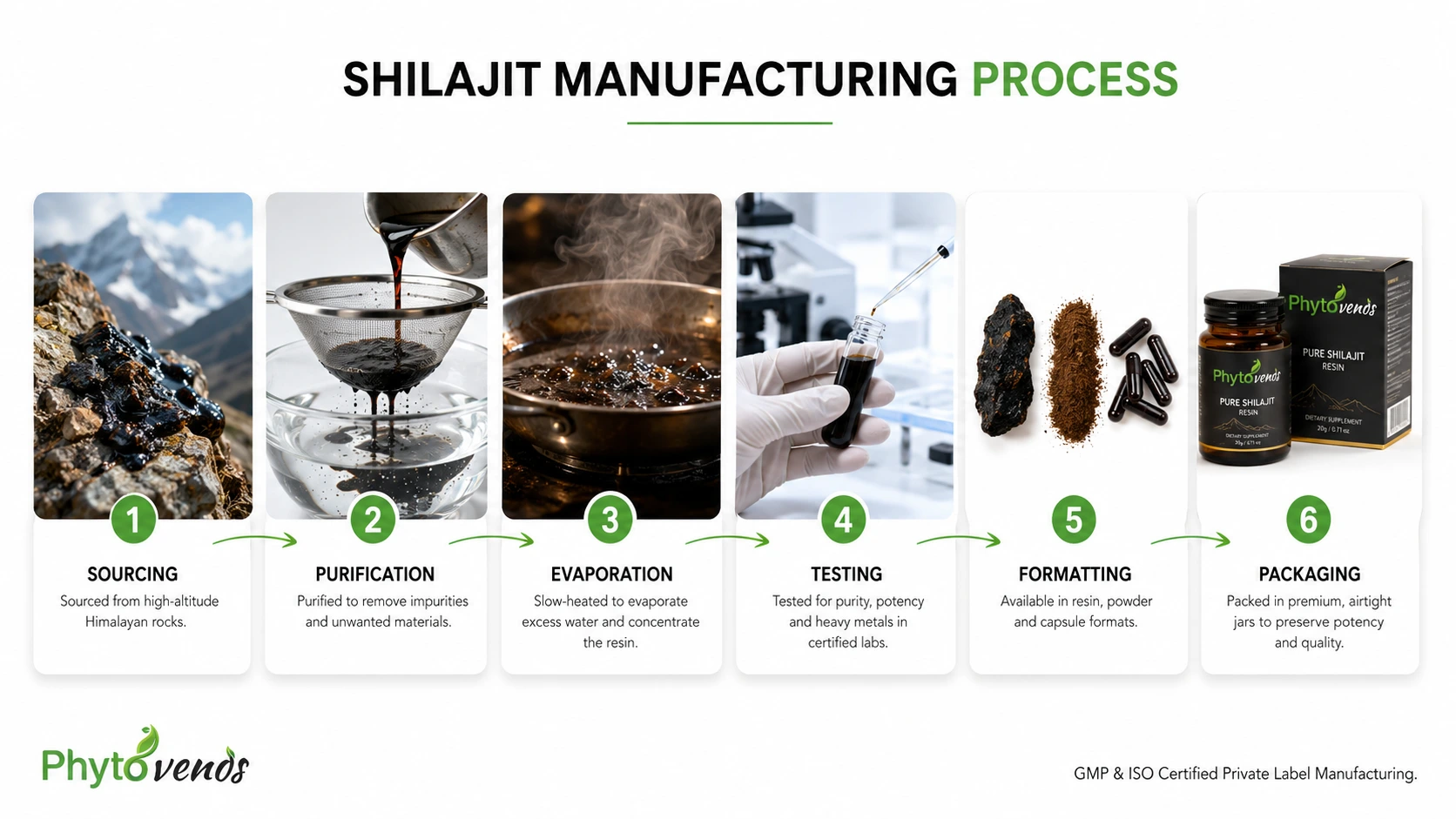
1. Sourcing. Raw shilajit is hand-harvested from rock crevices in the Himalayas, where it forms over centuries. It arrives mixed with soil, rock, and organic debris — the starting material for the entire shilajit resin production process, not a finished product.
2. Purification. The raw resin is dissolved in water and filtered repeatedly — traditionally called shudhikaran, the Ayurvedic shilajit purification process — to strip out everything but the shilajit itself. This step gets repeated multiple times, since one pass isn’t enough.
3. Evaporation. The filtered liquid is slow-cooked or sun-dried back down into a thick resin. Too much heat at this stage of raw shilajit to resin production destroys the fulvic acid the whole product exists to deliver.
4. Standardization and testing. The resin is lab-tested for fulvic acid content, heavy metals, and microbial safety. This is the checkpoint where GMP-certified shilajit manufacturing actually earns its certification.
5. Final format. The tested resin is packaged as-is, or turned into powder or capsules, depending on the shilajit product formulation.
6. Private labeling. The finished batch is packed under your brand — artwork, dosage, claims — and shipped.
Skip or rush any step in this shilajit manufacturing process, and the result is a product that’s gritty, under-tested, or weak on actives.
According to
Grand View Research
the global Shilajit market was valued at roughly USD 191 million in 2024 and is projected to reach USD 320 million by 2030, growing at about 9% a year — a sign of the rising private-label and bulk-manufacturing demand this page is built around.
Shilajit Side Effects – What to Know Before Use
Shilajit is generally well tolerated in purified, correctly dosed form, but it isn’t risk-free for everyone. Most reported issues come from low-quality or unpurified resin, or from exceeding the recommended dose — which is why sourcing from a GMP-tested manufacturer matters as much as the ingredient itself.
Shilajit Side Effects for Male
In men, the most commonly reported issues are digestive discomfort — nausea or loose motion — usually tied to high doses or poor-quality resin. Rare allergic reactions (itching, swelling) can also occur, and anyone on regular medication should check for interactions before starting.
Shilajit Side Effects for Female
Women may occasionally experience stomach upset, headache, or a mild increase in heart rate, particularly at higher doses. Pregnant or breastfeeding women, and those with hormonal or autoimmune conditions, are generally advised to avoid Shilajit unless a doctor approves it.
Shilajit Side Effects on Kidney
Shilajit itself isn’t established as harmful to healthy kidneys, but unpurified or excessive intake can add strain, especially for people with pre-existing kidney conditions. Sticking to a properly purified product, a sensible dose, and good hydration is the standard precaution here.
According to
The Yeti Life’s 2026 Indian Shilajit Market Report
an estimated 30–50% of Shilajit products sold through Indian e-commerce fail to meet their own label claims for purity — the exact quality gap that GMP-tested, lab-verified manufacturing (like the process outlined above) exists to close, and the main reason most reported side effects trace back to unpurified or low-quality resin rather than Shilajit itself.
Why Is Phytovends The Best Shilajit Manufacturer ?
You must have someone with your vision of quality, integrity and global success. At Phytovends, they don’t manufacture products, they make brands. They are a GMP approved Private Label shilajit manufacturer trained with rich knowledge of Ayurveda coupled with modern manufacturing skills, enhancing your pathway from idea to shelf. Phytovends has gained the trust of companies around the world for these reasons:
End-to-End Private Label Solutions
Phytovends offers a complete private label solution from product concept through product development, packaging, branding and finally delivery. Whether you intend to launch just one product or a whole line of Ayurvedic products, we will do this job carefully and methodically allowing you to concentrate on brand building.
Tailored formulations to match your brand.
Our Ayurvedic doctors and formulation experts work together with you to develop special formulations which feature your unique brand personality. Choose from a range of pre-formulated Shilajit products or, work with the client to design a product aimed at specific health needs, combining specific combinations of herbs and adaptogens.
FMCGs that can adapt to startups.
We figure that all visionaries should have a launchpad—that’s why we have low minimum order quantities. From new businesses to growth-oriented companies, bulk shilajit manufacturer provide your manufacturing needs with integrity and flexibility.
Become a Complete Regulatory and Compliance Assistance.
Keeping up with compliance can be a challenge. Simplified with Phytovends which holds FSSAI registrations, AYUSH approvals, GMP certificates, labelling regulations and export paperwork, is compliant, and legal to trade with the world.
Effective communication and meeting deadlines.
Trust and openness will help develop long term business relationships. This bulk shilajit manufacturer ensures you are up to date and on schedule with clients’ services, production schedule, and communication.
Conclusion
With the current fierce wellness market, it’s all about making an introduction to a new product that is of high value and distinctive in order to create a brand. Shilajit has an exquisite blend of old and new–and if produced responsibly, could be a game-changing product in your lineup. Contact the best shilajit manufacturer-Phytovends today for a consultation to begin production of Shilajit, samples or consult on your private label project.
Frequently Asked Questions (FAQs)
- Is there a certification of the products of Phytovends?
All Shilajit Products made by Phytovends are produced in the ISO, GMP and other regulatory certified Laboratories which ensures Maximum quality.
- Does Phytovends provide a private labeling facility for Shilajit products ?
Yes, Phytovends provides private labeling services, which enable businesses to market their own brands of Shilajit.
- Can I get a discount on Shilajit from Phytovends?
Yes, Phytovends does accept bulk orders of Shilajit products and provides good discounted rates for bulk orders.